Showing posts with label energy. Show all posts

Monday, February 27, 2012

'O Sole mio


by Emanuele Biestro

How the sunbeams become energy? What is the difference between the thermic solar energy and the photovoltaic one? Do the solar panels work even if it rains? the promoters of the European Solar Days, the most important information campaign europeanwide dedicated to the promotion of the use of solar energy as heat and electricity, will answer to all of these and many more questions. The campaign is co-funded by the European Commission within the programme "Intelligent Energy Europe", aiming at living a future energetically sustainable.

The campaign will be held from the 1st to the 13th of May in Italy and in other 16 European countries. In 2012 it will be the 5th edition: the figures of the past 4 ones show that there have been organized almost one thousand events with over 300.000 participants only in Italy. All the events on local, national or European scale dealing with solar energy will be part of the European Solar Days: the past ones were mainly fairs, products displays, workshops for children and students, guided tours to solar installations, training courses, information points, all of them with one aim: free the energy of the sun!

"For this year we expect a wide attendance. It is passed almost a month after the opening of the enrolments and we recorded already 16 events and other contacts for upcoming ones. We are trying to take advantage of the social networks, advertising the campaign on Facebook with a page dedicated to the event" say Concetta Laudicina and Riccardo Battisti, members of the National Secretary of the European Solar Days in Italy.

Actually, the strength of this campaign lives in the difference of the proponents of the events and as a consequence of the ways to communicate: the initiatives will be set by firms, NGOs, local authorities, schools or private citizens and they will be recorded on a list available at www.eusd.it, where through an interactive map we can see all the events programmed all over the Europe, promoted by local and national media.

The event will be organized in association with Ambiente Italia and Legambiente, and the support of Assolterm, Coordinamento Agende 21 Locali Italiane, Gifi, Kyoto Club, Qualenergia and Solarexpo.
More...

Monday, January 16, 2012

Green alternatives to the usual gym


by Anna de Polo

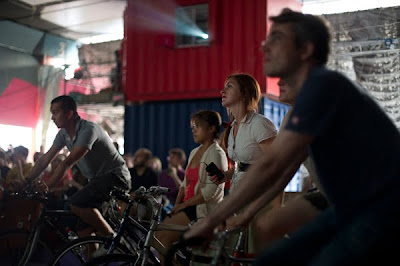
It cannot be said that Londoners don’t have imagination, when it comes to create new trends. Even when these involve keeping fit in an alternative way, combining physical activity and respect of the environment. So why not taking inspiration from them, if we have some weight to work off after Christmas, but the gym is not for us? Here are a couple of suggestions.Last summer along the Tames the new trend of pop-up cycle-in cinemas has spread over.

And what is it? Nothing that complex, in fact. The pop-up cinemas aren’t a novelty: if you have ever heard about them it’s because until yesterday they used to be called outdoor cinemas. Actually sometimes they are indoor, but in any case they are temporary, nomad if you like. Drive-in cinemas are a remembrance of the Fifties: maybe you have never been in one of them, but for sure you have seen them in some movie. So, imagine a drive-in, just with bikes instead of cars. But this is not all, because once arrived to the place by your bike you stay on it and, after having hooked it to the rack and connected to a mini-generator, you keep on cycling, turning into a kind of human dynamo. The energy produced in this way is used to project the film.

Adam Walker, of Magnificent Revolution, the organization that set up the first cycle-in cinemas, said: “We wanted to create Fifties-style drive-in cinema, but powered by bikes. We've done it on a smaller scale, but it was a lot of work. With 20 bikes everyone should be able to pedal gently”.

For whom interested in building up his own pedal-powered generator, so then he can produce energy while cycling at home, the no-profit organization Low Impact Living Initiative (LILI) offers two days courses at its base, a co-op housed in a Victorian mansion outside Winslow, Buckinghamshire.

Another alternative to the usual gym, which combines outdoor activities and love for nature, are the Green Gyms. They are work sessions lasting around half a day, during which you are guided in many different activities, ranging from horticulture to gardening. In a relaxed atmosphere, which encourages socializing (much more than in a normal gym), you have the opportunity to improve you practical skills, keep health and fit and contribute to the conservation of the local surroundings.

Probably it’s not by chance that what is “green” often intersects stimulating and funny activities that imply imagination, creativity and the ability to think outside of the box. If we make an effort to overcome physical and mental laziness, which often anchor us to the everyday grey routine, we can easily improve the quality of our life, as well as the one of the environment.
More...

Wednesday, November 30, 2011

To save energy has never been as easy as now: bet you


by Marzia Fialdini

Energy is valuable and we have to safeguard it. Within the domestic life, in everyday routine, we can reduce energy wastage through simple tricks, achieving consumption cut. On these bases, in 2009 was created Energy Neighbourhoods, a European initiative which put in competition hundreds of families in Ireland, England, France, Spain, Bulgaria, Germany and Belgium. They had to prove they were able to reduce energy consumption without investments or comfort loss.It’s the third edition of the initiative in France and several families living in Alpine regions have experienced an energetic consumption reduction by 8%: for example, switching off electronic devices or heating houses at no more than 19 degrees. During the six-months contest, participants received suitable technical support achieving an energy consumption reduction by 17% on average, saving 270 euros per family.

In Italy the initiative has been renamed Famiglie SalvaEnergia, and it’s spreading across several cities, in particular in the Genoa Province, in which it involves the municipalities of Lavagna, Serra Riccò and Arenzano in an energetic bet with their citizens. Groups of families engaged in reducing as much energy consumption as possible, in terms of electric and thermic consumption, just changing their habits and correcting their behaviors. From February to April, 2011, the Provincial Government committed itself to survey the event, and families achieved to reduce their consumption by 7%. FamiglieSalvaEnergia is one of the first standard actions promoted by the Province to its municipalities and has been included in every SEAP (Action Plan for Sustainable Energy) approved up to now. On December 1, the second edition of the initiative will start. The goal is saving by 9% of electricity bills, and has to be carried out between December 2011 and March 2012: the most virtuous families will be publicly awarded in May 2012.

The Genoa Province promoted the initiative after receiving a report on CO2 emissions on its territory: 45% of the emissions is due to buildings, and 60% of it comes from houses. Actually it’s possible to dramatically cut off CO2 emissions just changing our routine habits. Lowering by one degree the heating temperature or switching off stand-by pcs or televisions can enable to save energy, money and polluting emissions.

The three municipalities involved in the Famiglie SalvaEnergia program signed the “Patto dei Sindaci (Mayor’s Agreement)”, an EU’s initiative the accession to which is spontaneous. Signatories bind themselves to reduce by 20% by 2020 the CO2 emissions on their territories (main cause of the climate change), according to the EU policy.
More...

Monday, October 31, 2011

Eco-Cemetery: even the afterlife become ecological


by Marzia Fialdini

In this period traditionally dedicated to the commemoration of the dead, and if we consider an ecological living as the primary mean to improve the environment, then we should perhaps reflect on the fact that humans continue to pollute even after their death. How? It may seems incredible, but every funeral is a real threat to the environment: the coffins are often made with precious woods and toxic paints are used, cemeteries require expensive maintenance and a big quantity of pesticides is used to keep intact and fresh floral arrangements.

The new frontier of ecology then passes from the cemetery: the end of a life can represent a new impetus to the environment. Last year in March the first eco-friendly cemetery was inaugurated in Blackley, a small town near Manchester, central England city. In this area the bodies of the dear departed were placed in biodegradable and free of carcinogens coffins and marble slabs have been replaced by a rough stone or a tree, on which was engraved a figure, so that the earthly remains are uniquely traceable. Furthermore, the hearse has become electric and there is no need of gardeners, because the nature, running its course, thinks of everything. In the United Kingdom in a short time the green cemeteries have already reached 228 units.

In Holland, the environmentalists have proposed a fascinating idea: growing a tree from one’s ashes, helping to give new life to the Planet. In Australia on July 1 a somehow “revolutionary” eco-cemetery was inaugurated: no tombstones, so, to record and locate the exact position of the deceased, you have to use the GPS. The zero-impact cemetery is the St. Francis Field (owes its name to St. Francis of Assisi), at the Kemps Creek Cemetery in the western suburbs of Sydney. It currently has a capacity of 300 people, 300 real eco-dead who will reduce their footprint on the environment in life as in death. How? Everything inside the cemetery is natural and environmentally friendly: from biodegradable coffins made without the use of chemicals and with a zero emissions process, to the procedure of preparation of the body that takes place without using preservatives and disinfectants, thus facilitating the natural recycling. The use of a site is granted for a period of 30 years, after which it can be further renewed.

And in Italy? In our country since 2007 biodegradable coffins are available, but they are certainly not the most popular. However in 2010, for the first time, a design object called November Rain, focused on the importance of water, was created to use in cemeteries: it is life, so recover it, store it and reuse it are noble gestures that every human being should do even after his death. November Rain is a project of Andrea Vecera for a self-sufficient tomb, which recovers the water and also use it to generate electricity to power a led.

Nature has given us life, therefore it’s right that the body, after being buried, goes back to Her again. The cycle continues.
More...

Friday, September 30, 2011

The future? Renewable


by Eleonora Anello

Today the Google’s Doodle in Italy is dedicated to renewable energy. The six letters which compose the name of the most famous search engine in the world have been transformed in green energy’s symbols. Its authors are students of Borgo Rosselli’s Primary School in Porto San Giorgio (Centre Italy), winners of “L’Italia tra 150 anni” art contest.

With more than 20.000 votes “Avanti con energia!” won the contest, focusing on sustainable energetic technologies like wind and solar power, that are weel-adapted to our country’s features. We hope they can be used for more than 150 years and over. In the meanwhile we save this hopeful Doddle on our pc!
More...

Monday, September 26, 2011

Ravenna 2011: waste, water, energy and art


by Eleonora Anello

The “Ravenna 2011” cultural event is full off fringe initiatives. For the fourth year, visitors can admire the “Emergenze Creative” work of art. Many artists will take part in the initiative: Dacia Manto on waste, Elena Arzuffi on water and Massimiliano Pelletti on sustainable energy.

The exhibition, organized in collaboration with Labelab Laboratory, will be an occasion for the artists to share their environmental sensibility with a wide public, promoting a public art path across Ravenna’s historic routes, the same routes which will host the well-known environment festival.

In San Francesco square, among the arcade columns, the “Wood seer” big flattering sculpture will stand out, a piece by Dacia Manto focused on waste issue and in particular on waste materials reusing. The art installation is entirely made of old drawings made by the artist herself or by children involved in the project. The cloud-vegetation-like piece will take shape just in front of the public, who can take part in it bringing the artist their environment-themed pictures on September, 28 and 29, at 5 p.m.

In Piazza del Popolo Elena Arzuffi will work on water’s value,, inviting the public to take part in a kind of “gioco della campana (bell’s game)” with a “water square” instead of the classic “sky square”. Bringing back one of the oldest and most beloved children games, Arzuffi decides to pour the public’s fantasy out asking them three simple questions on water’s color, scent and shape. The most original answers will be edited on the Emergenze Creative website.

Lastly, in Piazza del Popolo we can admire “Rabbits in the sun”, a piece composed by sculptures of full-scale rabbits clustered around some glass jar capturing solar rays. The work of Massimiliano Pelletti shows how to produce energy and use it in a sustainable way. Indeed, during the day the piece captures sunlight to use it during the night lighting the funny rabbits. The recreational nature of this piece is aimed at intriguing young public, educating in the same time at using renewable energies.

We should not miss this interesting mix between art and environment, sharing the contemporary artists’ critical points of view on these matters.

More...

Wednesday, September 7, 2011

An apocalyptic goodbye


by Eleonora Anello

How does the world become without the use of renewable energy? This was figured out by Lecce 2080, articulated and complex ambient marketing campaign that in early summer has animated the streets of the city in Puglia. Through the original communication project, Nextwind, a company that deals with alternative energy, said goodbye to the market in this Italian region. In this way, the company has wanted to make people think about possible scenarios related to environmental choices that exclude low energy impact.

But let's see what it is. «The project we have packaged for Nextwind – the communication agency Utopya Minds Lab explain in a note - is a shocking campaign. The duration of the whole action was 45-days and was divided into 3 phases: teaser, transition and revealing. The beginning was marked by street marketing action which involved the placement of paper made eggs placed in strategic points of the city. Conventional and un-conventional means integrated together to hit multiple targets at different times. The concept is clear: in 2080 for not having kids-fish originating from genetic mutations and the sunken cities, now it is necessary make “alternative” choices. The tone of the campaign is a growing, from the melancholy record of the 'virtual diary' kept by the father of this imaginary baby (ndr Spigolino) on the lecce2080.it site on the determination of the complaint that the company wanted to do to give its version of events . As regards the results, we prefer to quote the numbers: the site had over 18,000 unique visits and over 23,000 pages were viewed. The Facebook Fanpage has collected nearly 1,700 preferences and more than 5,000 visits. We have been in more than 30 articles in paper and web and have been involved hundreds of blogs. With a readership of over 1,000,000 readers/users, the campaign has far exceeded the primary target (local) also reaching the secondary (national)».

One of the targets of Nextwind moral testament was to the Administration Region, and, perhaps, beyond all expectations, the campaign has hit even higher, becoming the subject of a parliamentary question, but it has not been viewed positively by all the citizens of Lecce, what one reads between the comments assigned to the local newspapers. «The wolf in sheep's clothing. That’s the Nextwind. Italia Nostra, GenerAzione, Biocontestiamo and all the Salento municipalities should "accommodate" the huge wind parks are fighting hard against the choice made by this company of 20 Italians, bah .... only a link that asks our money to government incentives, subtracts the land to the farmers and sells ready-made projects speculating Scottish and Spanish companies. Spigolino arrived in Parliament but rather a moral issue: is it right that a company that sells wind turbines creates terror to make Salento citizens accept the dirty choices with the dress of the green economy?».

So not all of them are intimidated. Somebody openly criticize the choices of communication, «“Awareness” Campaign? But please, do not make fun of us! This campaign only served to sensitize the people on the plant in Salento endless expanse of wind turbines. There is very little awareness. It is not talk about saving energy, reducing energy costs, educational and environmental aspects ... It is not talk about raising awareness of renewable energy, the real ones! Moreover, these gentlemen, paladins of the green-economy, do not even have decency to listen to the "against" voices. On the group page on Facebook, they delete the negative comments, and take away the right to write to the users who are against! It ‘s good that you know this too!».

So, without the happy ending, the Spigolino adventure has concluded.
More...

Monday, September 5, 2011

U4energy, schools compete to save energy!


by Francesca Morra

Can you teach students good habits in terms of saving energy? Can they learn to respect the environment by implementing small or big tricks? Can pupils and teachers together strengthen efforts in raising awareness of who is in and around schools? These are the challenges met by U4energy, pan-European contest devoted to energy education, organized by the European Commission under the Intelligent Energy Europe Programme and managed by Europan Schoolnet.

The competition involved 27 European Union member states, including Norway, Croatia, Iceland and Liechtenstein, with a total enrollment of 1,489 schools with 477 initiatives spread throughout Europe. In Italy were 3 schools for category A (students had the opportunity to design and implement an energy saving plan to reduce energy consumption in their schools); 9 for category B (this category is only intended for teachers, they have had the opportunity to present their lessons on energy efficiency at school having available methods, educational materials and teaching resources); and 10 for category C (led by teachers students have organized a campaign to increase awareness in their school making videos, posters, postcards and other communication material).

The European Commissioner for Energy GĂĽnther Oettinger underlined the importance of these issues in his speech duruìing the opening of the competition, which took place in September: “I am sure that through their commitment, their innovative spirit and creativity, students and teachers make U4energy an excellent platform to share skills and knowledge in the field of education and intelligent use of energy in Europe ". He also showed how students and teachers have a critical role when it comes to awareness. This, together with an extensive communicative action, makes the project a great place for kids to communicate energy saving when they facing a world increasingly energy-intensive, needing a deep awareness of the impact that the immoderate consumption have on the planet.

The winners of each category were selected by a jury composed of competent persons in the field of environmental issues and energy saving. The awards ceremony will be held in October in conjunction with the "3 days for school" with the participation of other five countries: Austria, Hungary, Malta, Slovenia, Czechoslovakia. Other ceremonies will be organized in multinational Lithuania, Bulgaria and Portugal; in Europe, the winners will gain international visibility in a high-level awards ceremony to be held in Brussels, where students and teachers will also visit the headquarters of the European Parliament. Waiting to see the winners we can keep in touch with schools and organizers by visiting the Facebook page.

This is a way of teaching good environmental practices, that start and arrive from schools to overcome the energy challenges of next years!
More...

Wednesday, July 13, 2011

Go green, but with an eye to the wallet


by Anna de Polo

A recent survey conducted by Accenture ("Revealing the Energy Values ​​of the New Consumer") revealed that 80% of Italians are in favour of choosing an alternative provider for the supply of electricity and energy efficiency programs, as long as this will translate into savings on their bill. Not that there was need for a statistical survey to find out that virtually we all agree to reduce the personal impact on the environment, but in practice we are committed to do so only if it reduces, or at least does not increase, the family costs. For this reason there are many Internet portals that offer practical advices to consumers to direct their purchases towards products that maximize value for money and, at the same time, comply with standards of environment quality.

Among these, one is Topten, an online search tool that allows you to compare various types of electrical equipments and choose the best from the point of view of not only energy efficiency but also the energy cost of the product in its entire lifecycle, as well as of the price, the brand and the aesthetic. The different products are classified into categories (e.g. cars, household appliances, lighting and office equipment) and are selected according to the criteria of energy efficiency, quality and the impact on the environment and health. This allows on one hand to raise consumers awareness about the impact of their energy consumption on climate change, and on the other to encourage companies to improve their energy standards.

Nothing really new in reality: just think of the energy labelling scheme (eco-labelling), which has so far proved to be a useful tool for consumers and effective for the environment, thanks to its high potential for energy savings. The new EU directive on eco-label has introduced several new novelties, including the requirement for energy labelling of TVs. The eco-label also becomes mandatory in case of direct sales, rental and also in distance selling, i.e. on internet. This legislation is part of the energy plan of the European Union, which is introducing more and more rules to achieve the target of 20% for energy efficiency by 2020. On 22nd June they proposed a new European directive that combines into a single legal instrument the earlier directives on the management of energy supply and final energy consumption. "Our proposal aims to make more efficient the ways to use energy in our daily lives - said Gϋnther Oetinger, European Commissioner for Energy - and to help citizens, public authorities and industry to improve managing energy consumption. This should also lead to reduced energy bills".

In conclusion, if on one side consumers are proving willing to engage more '"green" behaviours, on the other the energy suppliers and manufacturers are more and more stimulated, precisely because of this trend, to improve the energy efficiency of their products, thanks also to EU incentives. It remains to be seen whether this situation will trigger a virtuous cycle that will allow achieving the goal of 2020, from which for now Europe is still far away.
More...

Monday, July 11, 2011

Music is energy


by Eleonora Anello

Music as a means to spread environmental awareness? Of course it is, when its use has low environmental impact.

A study of the Observatory on environmental sustainability and music, commissioned by Edison in collaboration with Renato Mannheimer ISPO, has shown once again that in Italy we declare ourselves in favor of the environment but then we do little to protect it. 70% of the sample says they are very sensitive to environmental issues, although 39% does not implement any environmentally sustainable behavior.

From the published data it appears that the bigger problems are in the field of public transport. Very few manage to do without their cars to get to a musical event. And there's more. Some genres are greener than others: the most virtuous are those who love classical music, while the black jersey goes to the metal heads.

In this light, Edison, to spread a music more in line with the environment and develop a culture of sustainability and energy conservation in this area, decided to do its part by launching Edison-Change the Music, a contest addressed to emerging bands. Who will prove to be more environmentally friendly will open the concert by Jon Bon Jovi in Udine, July 17th. The project has been joined by several members of the musical world including Piero PelĂą, Elio e le Storie Tese, Enrique Iglesias, Annie Lennox, Omar Pedrini.

"There are many ways of doing business - said Andrea Prandi, director of external relations of Edison - With this project we believe that we can tie the theme of energy to that of environment conservation. Along with Legambiente we intend to convey to as many people as possible a message that encourages the sustainable use of energy resources. We chose music as a mean of communication, both in its popular expression and through more educated music. Indeed, we are also sponsor of the Prima della Scala. Edison-Change the Music has also become partner of the Sustainable Energy Europe Campaign promoted by the European Commission: this is a source of great pride for us".

If one energy company focuses on young people, another relies on stars, going on with well-tested projects. We are talking about Enel that, after the success of Safari Tour 2008, renews its collaboration with Lorenzo Jovanotti. "Ora in Tour Lorenzo Live 2011 - Music CO2 neutral" is a series of concerts across Italy, which began last April and will conclude at the end of this year. Its aim is to neutralize the emissions of the musical event with a program of reforestation and development in Cameroon. Each individual viewer may also directly participate in the initiative through the Compenso Positivo website, through which you can enter a raffle for a tree and give it its name.

"The collaborative project with Jovanotti -Enel says- is fully integrated in the commitment of the company to promote sustainability through a process that involves the use of renewable sources in energy production, the use of new technologies in the reduction and storage of emissions, measures of efficiency and energy-saving, the use of products with low environmental impact, information and awareness campaigns on the consumption of energy. In particular, the beginning of the tour of the singer coincides with the launch of "CO2 Neutral", the new Enel brand that identifies the services of Carbon Neutrality. Indeed we have been active for a long time in the volunteer market of the footprints for a wide range of services. Events, campaigns, sales of energy and other initiatives can be neutralized through innovative activities that reduce greenhouse gas emissions, contributing in a concrete way to improve the life on the planet and to the fight against climate change".

For years, however, environmental groups have tried to highlight other truths on the production of Enel. So much that some singers have decided to side with the citizens who pay the consequences dramatically. In August 2010, during the event Correnti Musicali, Simone Cristicchi, pressed by the environmentalists, refused to sing in the coal plant "Federico II" of Cerano (BR), which is not surprisingly dubbed “the plant of death", because it not only affects the beautiful landscape of Salento, hitting its tourism, but also keeps claiming victims among the inhabitants of the district. A dossier of Legambiente of 2007 has shown that the kindly-named plant, a true eco-monster that is located on the beautiful Adriatic beaches, produces over one third of total national emissions.

All this ambivalence between what is communicated and what is done can only create doubts and confusion.
More...

Friday, July 1, 2011

Environment from limit to value. A political experience


by Roberto Cavallo

The pages of the book by Renzo Penna “Environment from limit to value", subtitled “political and administrative experienc "(Editori Riuniti University Press) are 540, but when you have finished them you realize that they could have been even more and you would not feel hard to read.

The tone that comes from the pages is the typical one of those who approach environmental issues: enthusiast!

I met Renzo Penna while he was in charge at the Province of Alessandria as Councillor for the Environment, accompanied by his skillful staff and I immediately understood the cultural approach that he wants to give to his political mandate, and perhaps the main ingredient of his suffered, but resolute resignation.

Yeah, because anyone who deals with environmental issues sighting beyond the electoral mandate and interpreting the essence of sustainable development – the one caged by the Brundtland definition of leaving their environment at least in the same conditions in which it was inherited - is likely to be misunderstood.

And that's what we read in the pages of Renzo Penna; of that environment that perhaps for a while has been a limit for him, but that has suddenly turned into a value: the value is much more than the price, because you cannot buy the value is can buy, you cannot sell it, you cannot discount!

This is the feeling that takes the reader who reads the chapters of the Water, sailing firstly the Orba river and its contract of the river, then from the Tanaro and Bormida rivers, overcoming the tragic events of chemical pollution of ACNA insdustry and the flooding of 1994.

The value of human health and life, infinitely superior than the profit, is what characterizes the dramatic chapter on Air and the paragraph on asbestos.

I find again in the pages of the chapter on waste the real footprint left by Renzo and his administrative experience, that I had the fortune to live professionally. The stubbornly insist on wanting a provincial waste plan based heavily on waste reduction and materials recovery through door-to-door waste separate collection, beyond the political difficulties, makes Justice to Renzo Penna for having pioneered the EU directive that calls Member States and local authorities to set their own programs and plans.

The imprinting of the councilor Penna does not stop at his pages, but fortunately it is directly on the territory, so much so that according to the latest official data of the Piedmont Region are at least thirty municipalities in the province that recycle more than 65% of its municipal waste and some municipalities such as Bassignana or Castelletto Monferrato that have greatly reduced their waste to landfill and throw only 65 kg per inhabitant per year, just that if everyone does this, the Province of Alessandria wouldn’t have problems of urban waste management.

I would like to close with a small editorial critic. I saw better the chapter “Ecolavori” (Green jobs) as the closure, after the chapter on energy because Ecolavori has been and continues to be a unique experience at the national level, as I think unique was also the administrative experience of Renzo Penna that is so well described in the book I invite you to read.
More...

Monday, June 13, 2011

Global Wind Day 2011: there is wind of change


by Anna de Polo

The next June 15th it will be the Global Wind Day 2011, a day dedicated to the discovery of wind as a source of clean and sustainable energy. Launched in 2007 in Europe, the event has become "worldwide" since 2009 and has proven increasingly successful. The last year has indeed seen the participation of 29 countries, from Austria to Australia, from France to Japan, with over 220 events, including guided tours of the wind plants, conventions, children's workshops, trade fairs, exhibitions and much more. The project is developed through a network of partnerships coordinated by EWEA (the European Wind Energy Association) and the GWEC (the Global Wind Energy Council) and takes place in a historical moment in which the public opinion is particularly sensitive to energy, as emphasized by the chairman of EWEA, Arthouros Zervos: «Fukushima, the Arab spring and the oil spill in the Gulf of Mexico have created enormous public interest in the future of energy. Global Wind Day encourages citizens to find out for themselves how wind can make our energy supply more secure and environmentally friendly».

As for Italy, the information campaign on wind energy, already in progress for several days, is coordinated by ANEV, l’Associazione Nazionale Energia Vento (the National Wind Energy Association), which since 2002 represents the protagonists of the wind energy industry of the country. The organization is active both in the divulgation, based on real and monitored data, and on research, with the aim of reconciling the development of clean energy with the natural environment that hosts it, protecting the territory and promoting the employment. A correct information of the citizens is crucial so that the construction of new wind farms do not meet any resistance from local communities. From a recent statistics survey (data collected in May 2010), conducted by ANEV, it appears that 82% of Italians claim for increased information about wind energy and only 52% are aware of the criteria for disbursement of government incentives for wind power. Despite the lack of information, however, the collected data displayed that the wind energy has a good image profile: for 80% of Italians it is environmentally friendly, it is both an international (77%) and local (70%) economic opportunity and it is a source not subjected to economic and political crises (75%).

To celebrate the Global Wind Day, ANEV organized in Rome at the Villa Borghese Palaenergia a series of events, including conferences and seminars from 8th June and workshops for children (11-12th June), as well photo exhibitions and workshops to learn how to build kites for kite-surfing. The event will culminate on the 15th June, when there will be two conferences of ANEV with the titles: "Wind power: development and employment" and "Wind power: The clean, efficient and useful renewable energy".
More...

Friday, June 10, 2011

An indigestible apple

by Irene Gozellino


What did you have for breakfast? Did you enjoy the orange juice? Did the cheap and tasty yogurt from the discount satisfy you?
Where all this food came from? If the oranges weren´t from Sicily and the yogurt wasn´t made in the nearest dairy farm, be aware that what happens at the end of the video “Der Apfel” (the Apple) could be your destiny.

Der Apfel is one of the videos made for the “Internationale Sommeruniversität” (the International Summer University), which is hold annually in Karnitz, in the German region of Mecklenburg-Vorpommern.

The Summer University takes place simultaneously in Chile and in Germany, as part of a project that aims at the development of audiovisual and verbal competences as well as at the decrease of the “digital gap” among nations. The subjects of the audiovisual products are renewable energies and energy efficiency.

Joachim Borner is the scientific director of KMGNE, Kolleg fĂĽr Management und Gestaltung nachhaltiger Entwicklung gGmbH (The College for the Management and Design of the Sustainable Development), the Berlin body from which the Sommer University was born.

Why a partnership with Chile?
«This partnership with Chile comes from a history of friendship (date back at the time of Pinochet). It is a friendship with also a political connotation: with Gregory Cohen (director), Carlos Flores (director), Juan Pablo Orrego (alternative Nobel prize), Antonio Elisalde (sociologist), Raul Sohr (journalist), Gabriel Sanhueza (journalist) etc. We sustain each other through mutual encouragement and advice. This is the first reason of our friendship. The second one is the function of Chile as a transfer within Latin America. Starting from Chile, many ideas of participation and sustainable development spread among neighbouring countries. The coherence between ideas and actions is much stronger than in Europe, especially in Germany».

Participants come from different countries and also have various backgrounds. However they were able to shoot, within a very short time, effective and high-quality audio-visual products. In your opinion, how can they find a common way of thinking?
«It doesn’t always happen that, in such a short period of time, diversity becomes reciprocal understanding, through the exchange of ideas, but this is the final goal and it must be pursued. The transformations caused by climate change are quick, so we do not have much time. We therefore have to develop competences that enable us to communicate in an intercultural environment. We would like to understand each other (1. criterion) and to do so by using specific questions, supervisions etc. Developing a common language means working together on the message that is to be communicated (2. criterion). All cultural differences are taken into account – if that does not work, there will be, at that stage, no message».

To find what kind of messages and which new language have been developed by the students of the last Sommer University, take a look at the dedicated canal.
More...

Wednesday, June 8, 2011

Referendum campaigns teach bottom up environmental communication


by Silvia Musso

If the institutional public communication does not do its work, people move from the bottom.

In these weeks before the Italian referendum vote of the next 12th and 13th June, in fact it is possible to see real participatory democracy demonstrations.

While the broadcasters and the national media send only some confused message on the next roll, the web is a river full of links, video messages, images, websites etc. aimed at promoting the only instrument of direct democracy that we have in Italy.

If you look a bit, you’ll find a world of various initiatives throughout Italy.

We start from the WWF video campaign “Non farti prendere per il naso. Sono tutte bugie. Sconfiggile andando a votare”("Do not get caught by the nose. They are all lies. Defeat them going to vote"). There are three video messages ("Let's vote yes"; "The lies about the water"; "The lies about nuclear") characterized by the symbol of a long Pinocchio nose. The aim is, in addition to promoting the referendum, "unmask the lies on the water and nuclear" as stated by Stefano Leoni, National President of the Italian WWF in the first video.

On the issue of water privatization, over the referendum campaign "2 yes" for water as common good", launched by the Italian Forum for Public Water, whose Envi has already reported, at the local level have hundreds of initiatives developed. As the one launched by the City of Capannori that has designed and published a video on You Tube. The video has had many views and has attracted strong interest, as evidenced by the comments left by visitors themselves. Some are very appreciative, others, however, stress that it is too populist and naive. But everyone agrees on the importance of communicating the right and duty to vote.

About the question on the nuclear issue, the experience that seems more effective from the communication point of view, is that of 7 young people who have chosen to deprive of liberty for a month and living locked up in a shelter under clear radiation protection rules. Fully sealed and isolated they cannot eat fresh vegetables, cheese, milk, meat or fish. They live according to strict rules of radiation protection protocol provided in the event of a nuclear accident with release of radiation and have only the Internet to communicate with the rest of the world.

«It's an extreme act - as they themselves show on the site - to stress their No to nuclear power and defending the future of all. They will not get out until the referendum will cancel the nightmare of a return to nuclear power in Italy».

Their project, supported by Greenpeace, is called "You are the crazy people" and this slogan does not certainly need further explanation.

The website contains a logbook, ie messages, videos and daily reflections of these young people.
The countdown, day by day, reminds those who visit the site that the date of June 12 is coming and that all responsible citizens are called to answer.

Looking at the world of Facebook and YouTube music videos are multiplying. One of the most effective is "12th June" which some members of famous groups such as Mellow Mood and Africa Unite cooperated.

The refrain "on June, the 12th of June" is almost a mantra that gets in the head and does not let you anymore. A real subliminal message that reminds the listener that on June 12 we can express our right and duty to vote.

The thousands of people who use the social networks can, in addition to share links and videos, change their profile picture with specific messages that invite to vote as "I do not abstain - Battiquorum".

Then, if the quorum will be reached what better occasion to celebrate? Look in your city the barsa, clubs etc. that have joined the initiative “Vuoto a rendere”. On the evenings of the referendum (Sunday 12 and Monday, June 13), to those who will be in the possession of voting card special offers or discounts (amounts and details are at the discretion of managers) will be guaranteed. To obtain the discount you can simply show the stamp that shows the voter turnout.

The organizers of the initiative say: «We and managers of businesses do not care whether the X was put on the yes or no. Their decision to vote is free and confidential. This initiative is not related to any political party or referendum committee, nor does it give instructions to vote: it only aims to bring more people to the polls and encourage participation in Italian political life».

Where, in fact, public communication lacks, environmental communication is spreading from the bottom using new, innovative and effective channels that have a disruptive force and a skill to reach a large number of people.
More...

Friday, June 3, 2011

Tracks of M'illumino di meno


by Eleonora Anello

The most difficult variable to verify in the implementation of an environmental campaign is often the return. This age-old issue can be sum up in a specific question that, at the end of the campaign, all the experts is asking: how effective has been the communicative action carried out? Considering the showy yellow arrows that have sprung up recently in Lucca (Tuscany) on every electricity pole, it can be said that M’illumino di meno (I will use less light) has worked.

To join the initiative dedicated to energy saving that we extensively talked about, the City of Lucca and the GESAM decided to replace the old light bulbs with more energy-efficient
new-generation lights. The campaign known as “La via del risparmio” (The way of savings), has originated from a ride of the Mayor Mauro Favilla, the President GESAM Spa Claudio Riccardi and the President GESAM Energia, Giovanni Marchi, who first got in the saddle on three special exercise bikes, which have shown the flag on the facade of the Basilica of San Michele.

From Caterpillar they had revealed it to us with pride. However, despite the strong media response, the start of the campaign itself was for someone a little mystery that began on February 18th, 2011.

The idea has intrigued the residents and the tourists walking the streets of the Tuscan city and it represents a specific energy choice as well as an ideal way toward saving. The arrows represent an immediate and effective communication tool that aims to sensitize public awareness and inform it of the replacement or rehabilitation of approximately 150 unsafe and obsolete electricity poles. The modernization of the system provides a total replacement of about 1600 points of light with the use of energy-saving lamps.

The action is part of the project SINERGO (Integrated Electrical Services Renewable and Optimized), which sees the administration and the company working for a better use of energy and which involves the use of new technologies, especially in the renewable energy sector. In this way, Lucca intends to go on in the normalization of the power grid in order to achieve by 2020 the objectives of the Kyoto Protocol.

«Here is revealed the little mystery that we have created to sensitize public awareness of the issue of energy saving - confirms the President of Energy GESAM Giovanni Marchi - We hope that this "walk" along the new Savings Route will be a long trip, leading to a future in which electricity is no longer synonym of environmental pollution. This is a principle that is among the inspiring ideas of the project Sinergo, implemented by the Municipality with the GESAM group».

Who knows what the mayor has answered to those who pointed out the strong visual impact of the arrows hung in a city with such a high artistic value.
More...

Tuesday, April 26, 2011

Never again Chernobyl, Never again Fukushima


by Silvia Musso

France: 318; South Africa: 3; Germany: 13; South Korea: 2; United States: 7; Spain: 22; Italy: 46; Japan: 5… They are just some of the 459 actions that from 2nd to 26th April for 25 days have celebrated the Chernobyl disaster of 25 years ago.

“Chernobyl 25th anniversary - 25 days of actions. Let’s change with the times, and leave the nuclear behind!” is the name of the international campaign coordinated by RĂ©seau "Sortir du nuclĂ©aire", a network of 875 French organisations tha involve 108 partners everywhere in the world.

In these last months it was possible to adhere to the initiative registering own action on the website Chernobyl-day.org. The procedure was quite easy. “Organize actions” suggested some possible ideas to develop and replicable in every national or local context; “Register your action” made possible to insert alla the data and subscribe the action that became visible in the “List of actions”.

Actions that could be organized were multiple and with different impact and scope. You could for example print a sign Chernobyl-city and place it under the name of your city, organize meetings or information points, to organize a communication campaign using billboards and posters already available online on the site, demonstrations and protest marches and much more.

Objective of the organizers of these events is obviously involve as many citizens as possible to raise their awareness on the nuclear issue and especially support for the autonomy and independence of the WHO by the IAEA.

May 28th 1959, at the beginning of the programme “Atoms for Peace”, the World Health Organization adopted an agreement (law WHO 12-40) with International Atomic Energy Agency (IAEA) that subordinates the WHO to the decisions of IAEA. This agreement has allowed that all the dates about medical consequences of nuclear disasters of last years have not been communicated. The agreement WHO/IAEA denies the right to information, founding principle of democracy.

For our readers who also want to do something to make a gesture to mark the sad anniversary of Chernobyl maintaining high attention on the most recent disaster in Fukushima, we recommend to download the list of activities organized throughout the world to see if there 'is some event close to home. We would also like to suggest a book, a play and a new Italian campaign launched by the NGO Mondo in Cammino.

"Il naso lungo di Chernobyl. Fra scienza e libertĂ  di informazione" is the last book by Massimo Bonfatti (Carlo Spera Editore) where the the author systematically dismantles the lies of the IAEA on the Chernobyl disaster and reveals the treacherous and dangerous path of nuclear power since its inception.

"Girone radioattivo" is a play and an educational proposal inspired by the book Ulitsa Sadovaja and that intends to give voice, throughout the main character, to the thousands voices of Russian and Ukrainian citizens involve into the disaster.

"Mai piĂş Hibakusha" (Never again Hibakusha) is, finally, the Italian campaign launched by Mondo in Cammino in the Easter period, which this year coincided with the commemorations of the anniversary of Chernobyl, which the equivalent an Easter egg, or what you want, can be devolved to the "Children of Fukushima”.

As you can read on the association website: «At twenty-five years of the Chernobyl many are reminding the so-called "children of Chernobyl". It would be immoral not even remember the "children of Fukushima”, who, perhaps, need, paradoxically, greater support, as children of a double abandonment established by the policy of nuclear energy minimization and, ironically, by world community that considers Japan an economic power able to assist by its own their citizens».

So that "the voluntary for Chernobyl" also becomes "voluntary for Fukushima" we must re-engage to support actions such as these whose ultimate aim is the constant and consistent diffusion of punctual information and of a greater awareness.
More...

Wednesday, April 6, 2011

Aica is partner of Energethica Fair 2011


by Silvia Musso

“Energethica”, the fair of renewable and sustainable energy, at its 6th edition, arrives in Turin. It will be held since7th to 9th April, in Lingotto Fair. The fair, which attracts over 14,000 visitors from all over Italy and 19 other countries, is divided into different sectors and offers a rich program of conferences and initiatives that will provide the visitor ideas to reflect and discuss.
Energethica in these six years, has expanded: from a simple show has become a real circuit that supports the development of the field of energy coming from renewable and sustainable energy. Among the fair’s partners there are also AICA – International Association for Environmental Communication - and ERICA soc. coop. Environmental Educaion, Research, Information, Communication.

«As AICA and ERICA presidentRoberto Cavallo claims – I’m glad to participate and collaborate to the sixth edition of Energethica. The two subjects welcomed the opportunity to become partners of this Fair, that this year has decided to open its borders to different a new environmental topics such as the waste management. For the past 15 years, in fact, ERICA has been committed throughout Italy and especially across the Piedmont, in the implementation of communication campaigns aimed to raise public awareness about recycling and waste prevention, recognizing the importance of these actions to achieve the virtuous waste management that is required by European legislation. Another mission of ERICA as well as of AICA is also the environmental communication. There is no sustainable development without the involvement of citizens and their constant information».

AICA and ERICA are present within Energethica with a stand that will hold training and education moments addressed to children and a forum where a space will be given to various organizations and associations that will have the opportunity to present themselves and their projects in the environmental field. On Saturday 9 at 2.30 p.m. there will be also the end the conference: "Local composting: save money and reduce emissions. Experience and innovative solutions across Europe". The speakers, including Agata Milone of Piedmont Region (Italy), Edoardo Guerrini of Turin Province (Italy), and Jean Marie Savino of the City of Nantes (France), will present examples from across Europe to create local composting.

More information are available on the website: www.energethica.it.
More...

Wednesday, March 16, 2011

ARK: the new fully eco-sustainable hotel… floating


by Francesca De Matteis

It has a charming, is a technological marvel and is completely environmentally friendly: it is the most modern and ecological hotel, which has been heard, the ARK.

The abrupt and increasingly important climate change as the global warming and rising sea levels are the reasons that prompted the Russian architect Alexander Remizov, in collaboration with the German engineering company and the scientist in Moscow Lev Britvin, to design a project so ambitious and innovative.

The building, completely self-sufficient thanks to a system of generators for wind and solar energy, is uniquely shaped dome, «Its unique structure promotes the formation of air turbulence - reports Remizov - strengthening the work of wind turbines and promotes the accumulation of hot air at the top of the building. This heat will be turned into other types of energy to be collected even in the heat storage units».

The hotel was designed in order to accommodate about 10,000 people and provides an extension of 14,000 square meters. What is striking about this building, in addition to recyclable materials used, such as wood and plastic EFTE high strength, is the speed of creation: a building of this type may in fact be realized, according to its creator, in truly record time, 3 or 4 months at most.

It has also being foreseen a floating "version" thanks to a special honeycomb-shaped hull that allows the water line and at the same time exploit the heat of the water. It will allow us to survive the natural disasters caused by climate change.

The tourism sector, through spectacular and futuristic buildings as Ark, can help people to reflect on certain aspects related to renewable energy and the environment, leading to undertake more sustainable lifestyles, thanks to special and evocative forms of interaction. At the moment the project is just an idea. Expect generous donors!
More...

Monday, March 14, 2011

Let's play?


by Eleonora Anello

At the end, even the IPA (the Italian Institute that disciplines the advertising) decided that the chess game was rigged! Maybe the verdict was not sufficiently widespread, but the spot of the Italian Nuclear Forum, that we had talked about during its broadcast, it was deemed misleading.

The authority called to monitor the advertisements says: «The ad aims to the public in the style of a neutral communication and information, as if it were a social communication. Precisely because of this, the message is flawed for lack of transparency about its promotional, about the product it aims to promote (nuclear energy and its choice), about the identity of the advertiser and its communication part. Thanks to an apparent show of impartiality with respect to the interests involved, the message uses an extremely effective persuasive technique, which is however very unfair, putting themselves therefore contrary to Article 2 of the Code, as it carries statements and representations that may mislead the public in relation to the real identity of the advertiser, and then press the promotional purposes».

To remedy this, the Forum was added enough "We are in favour”, the final words that reveal the true intentions.

Rigged or not, we consider it a Pyrrhic victory. A win all in all useless. The control machine that monitors the communication has worked, but It has been emitted when the campaign of the Forum was no longer on the air and had the opportunity to show visible its effects. The corrected and amended version of the video, can be viewed only online. In short, the sentence seems a bit 'too small compared to the effect that the spot, disguised as a social campaign, has had on target.

For this Greenpeace, an association that has fought for the campaign for nuclear to be postponed, waiting for the sentence, has not been watching. It responded with another campaign, made up of a site and a video, though very clicks on the web, did not have the space and the planning of Nuclear Forum. Salvatore Barbera, head of the anti-nuclear campaign of Greenpeace Italy, aware of the imbalance, made his request: «Given the decision of the jury, asking to broadcast our commercials on television for a true balance in the discussion on the return of nuclear in Italy. We fear, however, that will apply the strategy of silence so as not to say that in a few months there will be a referendum on nuclear power also».

The approach of the referendum has sparked a lively and tough competition in communication between the different factions. This is the case, again, to hope to win the best?
More...

Thursday, February 17, 2011

“I will use less light” lights tricolour


by Eleonora Anello

Effective campaign, able to engage a cross target activating positive dynamics for the change. This is “M’illumino di meno” (I will use less light), an initiative designed by “Caterpillar”, transmission broadcast on Radio2 hosted by Massimo Cirri and Filippo Solibello, now in its seventh edition.

Like every year, coinciding with the anniversary of the entry into force of the Kyoto Protocol, aimed at combating the climate change, citizens, municipalities, companies and associations are encouraged to review their energy choices.The highlight of the campaign already started on January 24th, is expected to black out of Friday, February 18th, 2011, when we turn off our energy- and impacting electric lights for the sustainable tricolor. In fact, this year's the theme is the unification of Italy. Then off to the imagination to come up with spectacular and attractive initiatives.

To date more than 3000 initiatives have been recorded on the web platform that supports the event. Great importance was given to the target represented by the municipalities. So much so that in the special episode of 18, 150 mayors will swear allegiance to renewable energy. On air and then links that will give visibility to the most important initiatives. «There are many initiatives - said Filippo Solibello satisfied - from the municipal council of Lucca (Tuscany), the mayor in the lead, will ride with beams of light to illuminate the Italian flag on the City Hall, from the Valley of the Temples in Agrigento (Sicily) that to turn off the lights in the archaeological area, with the exception of the Concordia Temple, illuminated by the colors of the flag. In Lecco (North Italky) instead there will even be a parade to an estimated 1,000 people attended the tricolour torch».

At Isola del Piano (Marche) will turn off the lights of the centre and will be served a drink in the moonlight accompanied by the launch of three balloons, one green, one white and one red, all wrapped in a tricolor 2.5 × 5 meters exposed on the facade of the City building. Then a bio-tricolor Km 0, candlelight dinner will be served, in which everyone takes home the pot, to avoid generating unnecessary waste. The course will be accompanied by live music.
A little farther on, in Monte Grimano Terme, at 18 o’clock will be turning off all the public lights for 10 minutes. The facade of the Town Hall will be illuminated by three-color LED lights and it can attend the concert of “M'illumino di tango” without amplification, and by the light of candles.

In Varese (Lombardy) is seeking cyclists volunteers. Legambiente decided to bring in Garibaldi Square a "stationary bike" that will involve 150 riders, one for each year from the unification of Italy, to emphasize that every citizen is responsible for a piece of history. To participate, just be fitted with a bicycle dynamo illuminated in three colours green, red, and white.

Also in Lombardy region, in Morbegno "With the torch to handle the atmosphere is even more beautiful", you can participate at a fascinating tour of the Museum of Natural History. There will be music and hot drinks.

Finally, in Cherasco (Piedmont) until later this month, also the art illuminates itself less and better. The art gallery Evvivanoè will participate in the campaign by displaying a big heart in three colours, illuminated by LEDs. «Our scenographic setting allow you to see (really) in a different light the works of art exhibition" Pieces of My Heart ", by the illustrator Elena Mirandola», anticipate us Sara Merlino of Evvivanoè. In exhibition therefore hearts painted on wall paper, wrapping, road maps, maps and decorative paper.
More...